

SECURITY STARTS WITH PEOPLE
Human Risk Management for Modern Organizations
Cybersecurity is no longer just an IT issue, human behaviour plays a big factor.
The Biggest Cybersecurity Risk Is Often Human Behaviour
Most cyber incidents do not begin with sophisticated attacks.
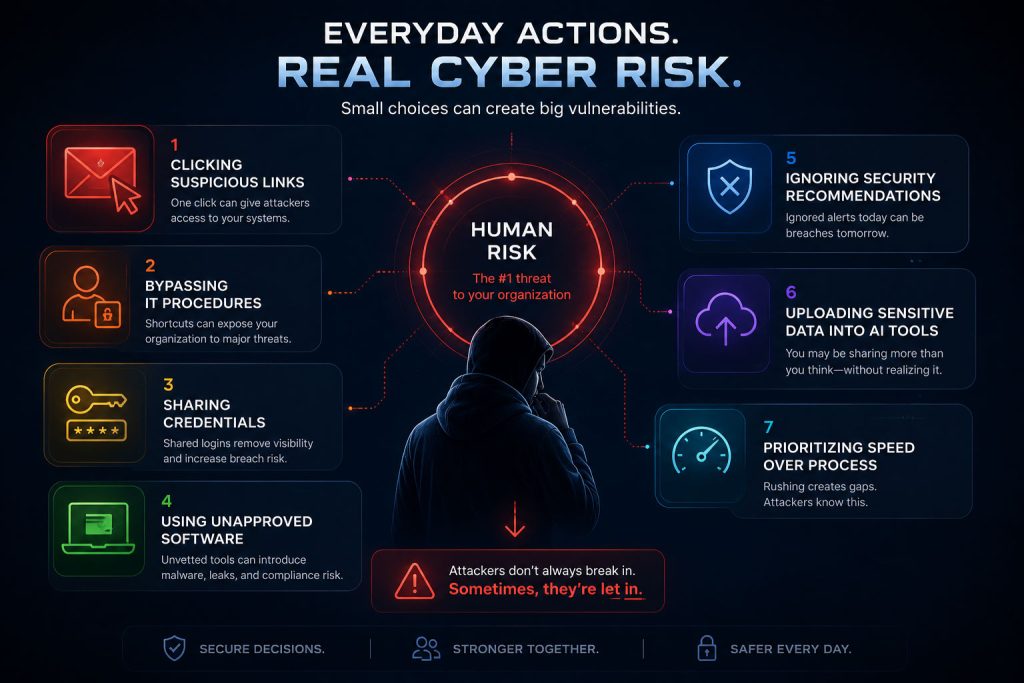
They begin with everyday decisions:
- clicking suspicious links
- bypassing IT procedures
- sharing credentials
- using unapproved software
- ignoring security recommendations
- uploading sensitive data into AI tools
- prioritizing speed over process
Organizations invest heavily in cybersecurity technologies, but even strong security stacks can be undermined when operational behaviors create exposure.
Modern cybersecurity requires both technology and human accountability.
PROCUREMENT & SOFTWARE GOVERNANCE
Software Procurement Is Now a Cybersecurity Issue
One of the fastest-growing cybersecurity risks is uncontrolled software adoption across departments.
Employees often subscribe to SaaS platforms, AI tools, browser extensions, cloud storage platforms, or third-party integrations without security review or procurement approval.
While the goal is usually productivity, the result can introduce:
- data exposure
- compliance violations
- weak vendor security
- unauthorized integrations
- uncontrolled permissions
- operational blind spots
- shadow IT
Cybersecurity teams cannot protect systems they do not know exist.
What Organizations Need
- Vendor review processes
- IT approval workflows
- AI usage governance
- Procurement security checkpoints
- Access management policies
- Third-party risk assessments
- Software lifecycle controls
- Employee accountability standards
FOLLOWING IT & SECURITY RECOMMENDATIONS

Security Policies Only Work If People Follow Them
Many cybersecurity incidents occur because security recommendations were ignored, delayed, or bypassed.
Common examples include:
- Delaying software updates
- Disabling MFA
- Password reuse
- Sharing credentials
- Approving suspicious invoices
- Clicking phishing emails
- Connecting unmanaged devices
- Bypassing secure workflows for convenience
Cybersecurity failures are often operational behavior failures before they become technical failures.
Organizations need leadership alignment, process accountability, and ongoing reinforcement around cybersecurity practices.

AI Is Changing Human Risk Exposure
Employees are increasingly using AI tools without fully understanding the risks.
- Where data is stored
How information is retained - Whether prompts are secure
- Who can access uploaded information
- What data should never be shared
Without governance, AI adoption can introduce:
- Sensitive data exposure
- Compliance risks
- Intellectual property leakage
- Misinformation risks
- Uncontrolled external access
Organizations need practical AI governance policies that balance innovation with operational security.
SERVICES / CAPABILITIES
Human Risk Management Areas
Security Awareness Programs
Practical cybersecurity education focused on real operational risks and employee behaviors.
Procurement & Vendor Governance
Processes for evaluating software, vendors, AI platforms, and integrations before adoption.
AI Usage Governance
Policies and operational controls for responsible AI adoption across teams.
Phishing & Social Engineering Readiness
Improving awareness around manipulation tactics targeting employees and leadership.
Security Policy Alignment
Helping organizations improve adoption and compliance with internal security standards.
Insider Risk Reduction
Reducing intentional and unintentional risks caused by internal users or operational gaps.
Remote Workforce Security
Supporting secure remote work practices, access management, and device security.
Operational Security Processes
Embedding cybersecurity into onboarding, procurement, approvals, and daily workflows.
Practical Cybersecurity Built Around Real Human Behavior
Building stronger cybersecurity cultures through awareness, accountability, and operational resilience.
Citadelis helps organizations reduce human-driven cybersecurity risk through operational governance, awareness strategies, procurement guidance, AI governance, and practical security-first processes.
Our focus is not fear-based cybersecurity.
Our focus is operational resilience, accountability, and reducing avoidable risk exposure across the organization.

Frequently Asked Questions
Human risk management focuses on reducing cybersecurity exposure caused by employee behavior, operational processes, and organizational decision-making.
Shadow IT refers to software or systems adopted without formal IT or security approval.
Every software platform, AI tool, integration, or vendor can introduce operational and cybersecurity risk if not properly reviewed.
AI tools can expose sensitive information and create compliance risks when employees use them without clear policies or safeguards.
No. Cybersecurity affects operations, procurement, HR, finance, leadership, and employees across the organization.
HUMAN CENTRIC CYBERSECURITY